


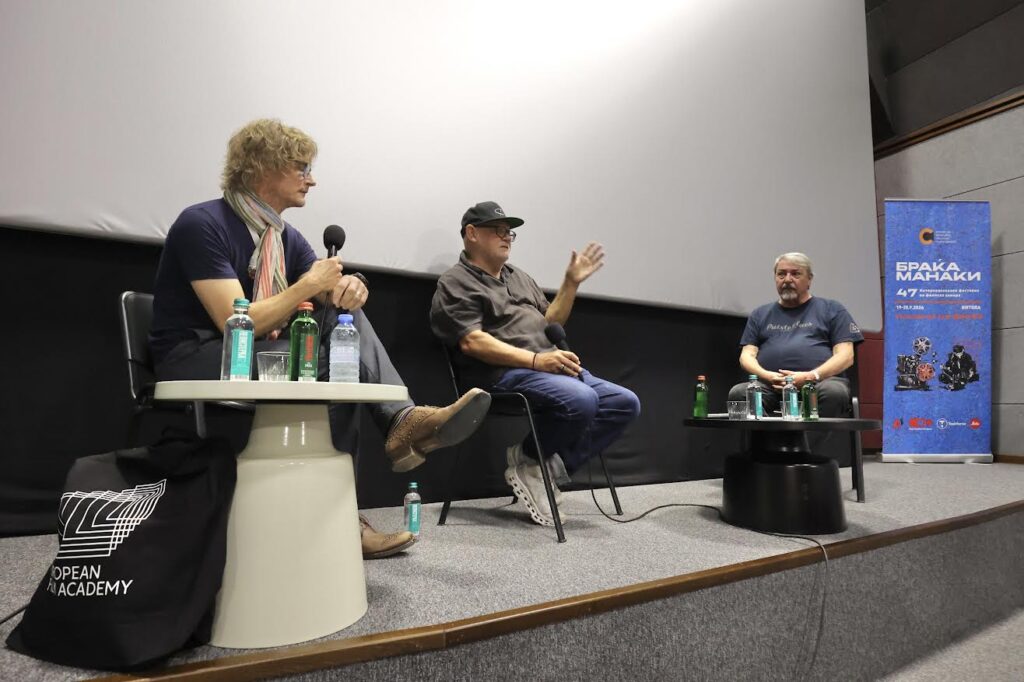
How to find new ways to reach the heart and mind of the audience? The panel discussion “Finding new ways into the audience’s heart and minds” was held today at the 47th edition of ICFF “Manaki Brothers”, organized by EFA/MFPA, with moderator Matthias Fleischer. The guests of the panel were renowned cinematographers Timo Salminen and Janusz Kaminski.
Talking about his path to cinematography, Timo Salminen looked back on his family and his beginnings in film. His father was the director of 36 films, and when Salminen was 23 years old, his brother was already working as a director of photography.
“That’s how the film ‘took me’,” said Salminen, who first worked as an assistant director of photography, in parallel with his film education. Later he worked as a freelancer on commercials and then on feature films.
Salminen is known for his long-term collaboration with Finnish director Aki Kaurismäki, with whom he created a recognizable visual world in films such as Shadows in Paradise, Ariel, The Match Factory Girl, The Man Without a Past, Le Havre and Fallen Leaves.
Janusz Kaminski talked about working on the film The Diving Bell and the Butterfly (Le Scaphandre et le papillon), directed by Julian Schnabel. The film follows the story of Jean-Dominique Bauby, who after a stroke remains completely paralyzed and wakes up after several weeks of coma. To capture his subjective experience, Kaminski used a variety of optical and camera techniques, including lenses with which he could selectively control the focus and create an unstable, distorted perception of space.
The manipulation of focus, movement, and shooting speed were not just visual experiments, but means for the audience to experience the world from the protagonist’s perspective. This is precisely what Kaminski sees as the essence of cinematography, that technology should be serve the story and emotion, and not itself.