


How does one become a cinematographer? Who teaches the craft and to what extent can knowledge
gained on set be passed on to future generations? These questions were the focus of the panel
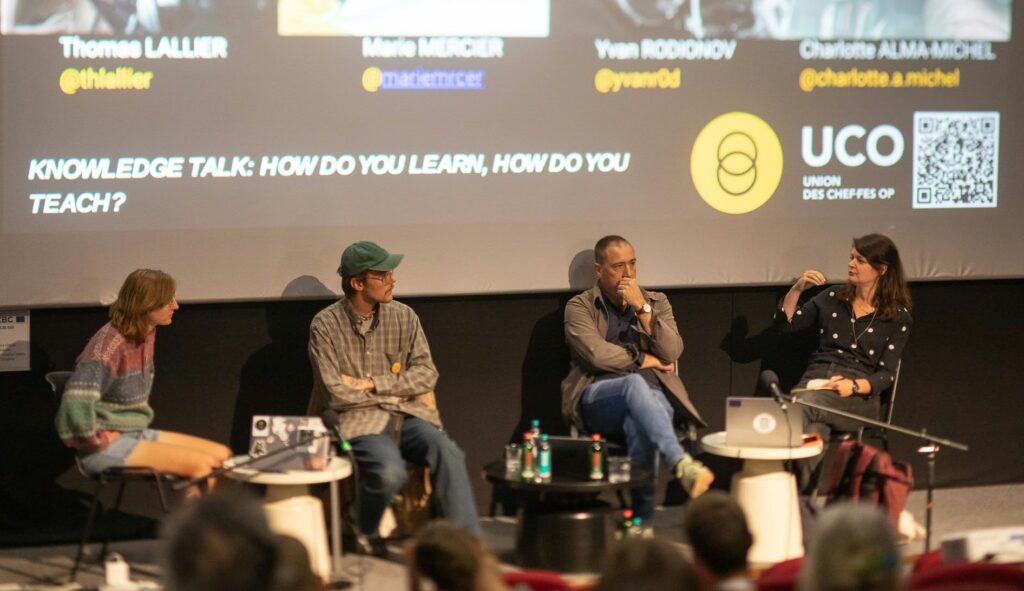
discussion “A Conversation about Knowledge: How You Learn, How You Teach,” held at the Manaki
Cinema as part of the 47th edition of the “Manaki Brothers” International Cinematographers’ Film
Festival.
The panel featured members of the United Cinematography Organization—Charlotte Alma-Michel,
Thomas Lallier, Marie Mercier, and Yvan Rodionov—who shared their diverse personal paths into the
profession, as well as their experiences regarding the best ways to learn cinematography: in school, on
set, and through collaboration with colleagues.
For Yvan Rodionov, formal education did not cover every aspect of the profession.
“Learning can be particularly challenging for freelancers. My experience has shown that a great deal of knowledge comes from working together and exchanging ideas. There were only five students in my class; we realized that we functioned as a team and could learn a lot from one another,” he said.
Marie Mercier recounted that her journey into cinematography began in a completely different place—with biology studies. Her initial wish was to participate in scientific expeditions and film them. Later, she began working on documentaries, and today she studies at a technical film school, where she is particularly drawn to lighting work.
“I am still studying and learning a great deal. We talk a lot and learn from both the professors and the other students,” Mercier said, emphasizing the importance of learning through dialogue and the sharing of experiences.
Charlotte Alma-Michel shared a similar experience; as a child, she loved animals and had considered becoming a veterinarian. Her decision to pursue a career in film came later, and without any prior knowledge of how films are made. Consequently, her current educational experience is shaped by the way a teacher interacts with students.
“I learned that, as a teacher, you shouldn’t traumatize your students,” she noted, drawing a parallel tothe work on a film set: in her view, a cinematographer should not feed their own ego through their treatment of assistants.
Thomas Lallier, on the other hand, acquired his knowledge the hard way. He is not a professor, but a professional hired to teach. He himself had been rejected when he tried to enroll in film school in Paris. He started out filming with old video cameras, then gradually made his way onto film sets, working as a set photographer.
“For me, it was the harder path,” said Lallier, noting that when he began his professional journey, there was no internet and access to information was significantly more limited.
The participants’ diverse stories demonstrated that there is no single path to becoming a cinematographer. Some knowledge is gained in film schools and through practical work, while a great deal comes from colleagues, assistants, mentors, and actual on-set experience.