


Film professionals in Europe are facing a range of challenges – from reduced film production funds and working conditions, to the need for greater cross-border cooperation and the growing impact of artificial intelligence. How the film industry can survive and thrive in a rapidly changing environment was discussed at the panel “Navigating Industry Change: How to Survive and Thrive in Film and TV Production”.
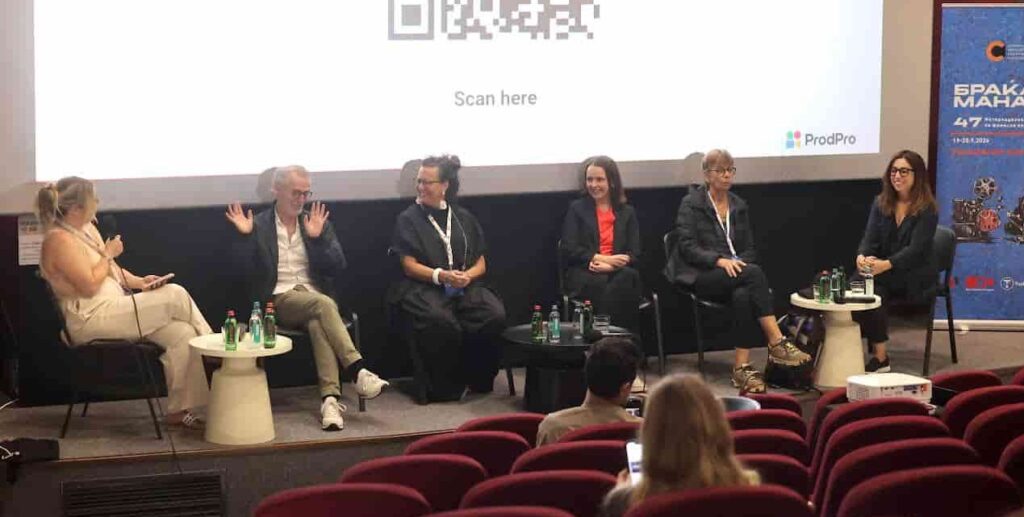
The panel, moderated by Christina Nowak from ProdPro, included cinematographer Dan Laustsen (ASC, DFF), Reetta Turula from the Film Commission of Northern Finland, Susan Ronand from Screen Malta, Athena Xenidou from Ray Talent Agency and Olympia Mytileneou (GSC). The message from Finland was that the potential for the development of the film industry exists, especially through cooperation with neighbouring countries.
“It is possible for the Finnish film industry to grow. The Nordic countries, especially Sweden, are important partners, and we also cooperate with the other Nordic countries. The Baltic countries have larger studios, so we often work together. We can learn there, and then transfer our knowledge to Finland,” Reetta Turula pointed out.
The situation is different in Greece, where financing remains one of the biggest problems for the film industry. Olympia Mytilinaiou also talked about the challenges women in the industry face, but also about the consequences of the economic crises in the country.
“In Greece we have a problem with money. In recent years we had two political and financial crises, and film was a victim and still is. Now there is a new law. Not much money is given to films, but games, series and television formats are funded,” said Mytilinaiou.
She pointed out that the possibility for international cooperation is one of the important tools for overcoming the limitations of small markets. As an example she cited the possibility of hiring cinematographers and other film professionals from different European countries.
According to Mytilinaiou, a broader European view of filmmaking is also needed, i.e. a greater understanding of the differences between national cinemas and their needs.
Susan Ronald from Screen Malta also addressed the need for support for local crews. She also raised the issue of working hours and overtime on film productions.
“A film is made with overtime, so hours are a problem. This needs to be standardized,” Ronald said.
According to her, when it comes to a small film industry like the Maltese one, it is especially important to give young professionals the opportunity to gain experience.
“When you’re a small country, the question is how are you going to prove what young people can do if you don’t give them a chance?” Ronald pointed out.
Athena Xenidou spoke about the importance of European funds and co-productions, assessing that it is precisely cross-border connections that can open up space for the development of film professionals and productions.
“Europe has the opportunity for filmmakers to make a difference. We have access to European funds when we are in a team. We have cooperation with Greece, Germany, Hungary. Things are possible, we just need to use the funds,” Xenidou said.
She emphasized that European support should include both countries with large production capacity and smaller cinemas, for which co-productions are often essential.
“The opportunity for co-production keeps us alive,” Xenidou added.
Cinematographer Dan Laustsen, meanwhile, talked about the changes that artificial intelligence is bringing to the film industry.
“I only work on big American films now. The impact of AI is very big and we don’t know where it will lead. That’s a problem,” Laustsen said.
The issue of AI use was also raised by Turula, who stressed that technology should be a tool, not a replacement for the creative process. According to her, if a film professional has to attribute authorship credit to AI for their work, this could be a sign that the technology is being used in the wrong way. She said that producers and film professionals should have control over the way AI is used in production.