


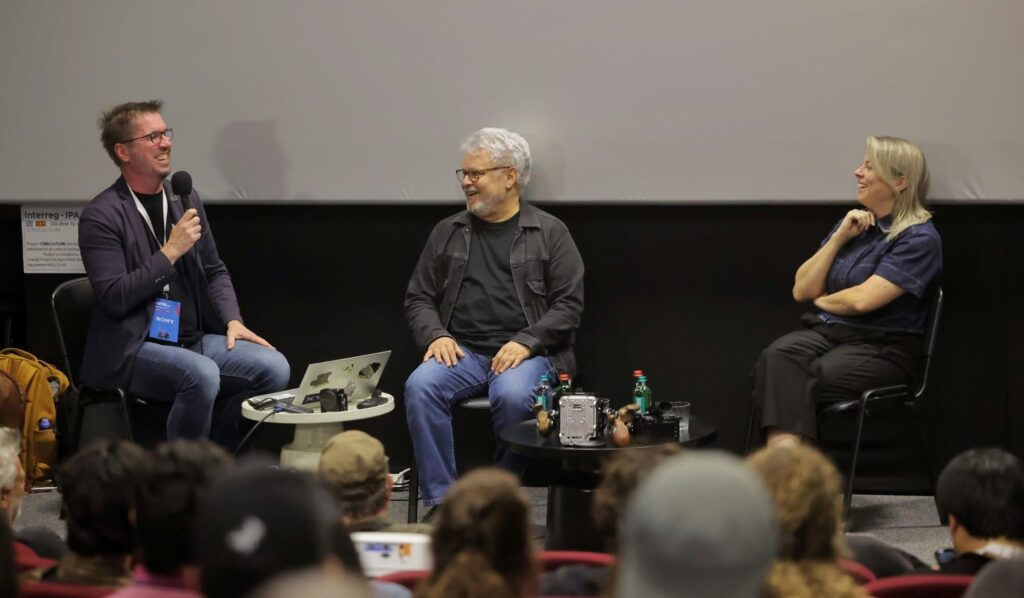
Cinematographers Mustapha Barat (ABC) and Rachel Clark (BSC) spoke today at the Manaki Cinema about the path to becoming a cinematographer, film preparation, the equipment selection, and on how to create a distinct visual world. Their discussion took place during the Sony “In Conversation” presentation, held as part of the 47th edition of the “Manaki Brothers” International Cinematographers’ Film Festival. The conversation was moderated by Sebastian Leske from Sony.
Barat recounted that his interest in film began within his family, as his mother worked in the film industry. He first set foor on a film set at the age of 18, and the film director was already aware of Barat’s desire to work behind the camera. He studied film and subsequently worked as a second camera assistant.
“Sometimes you have to learn from the opportunities presented to you, but also from the work of other cinematographers,” Barat said, reflecting on the experience he gained across various productions.
He also discussed shooting with the Sony VENICE 1 on a production that spanned different time periods, ranging from the 1950s to the present day. According to him, a significant portion of the visual outcome is established even before filming begins.
“There is extensive preparation before a film is shot”, Barat noted, explaining that various lenses were used during production to achieve a specific visual look.
Rather than striving for complete realism, the aim was for the film to create a fantastical visual world. Virtual production played a significant role in this process. Production took place across three studios, involving a large team of professionals and substantial production resources. The camera and the full array of lenses were set up in spacious studio environments that allowed for free camera movement.
Clark also spoke about her journey into cinematography and her early days in the industry. She had studied photography and wanted to pursue a career in visual storytelling, and the film industry initially seemed mysterious and unfamiliar to her.
“I was very shy, and the film industry was a mystery to me”, recounted Clark, who started out as a production runner before gradually transitioning to work behind the camera. As part of the presentation, Clark showed specific scenes from the film “Finding Emily”, explaining how they were visually planned and executed. Among them was the prom scene featuring a live band.
When talking about working on set, Clark noted that capturing the perfect shot sometimes requires the cinematographer to assume physically unusual positions. The camera must be placed wherever necessary to achieve the precise angle, movement, and composition—even if that means the operator’s own position is awkward or unconventional.
Through specific examples from their productions, the discussion offered insight into the process behind the film’s visual style—ranging from the choice of camera and lenses, through pre-production and virtual production, to the physical work on set and the constant pursuit of the perfect shot.