


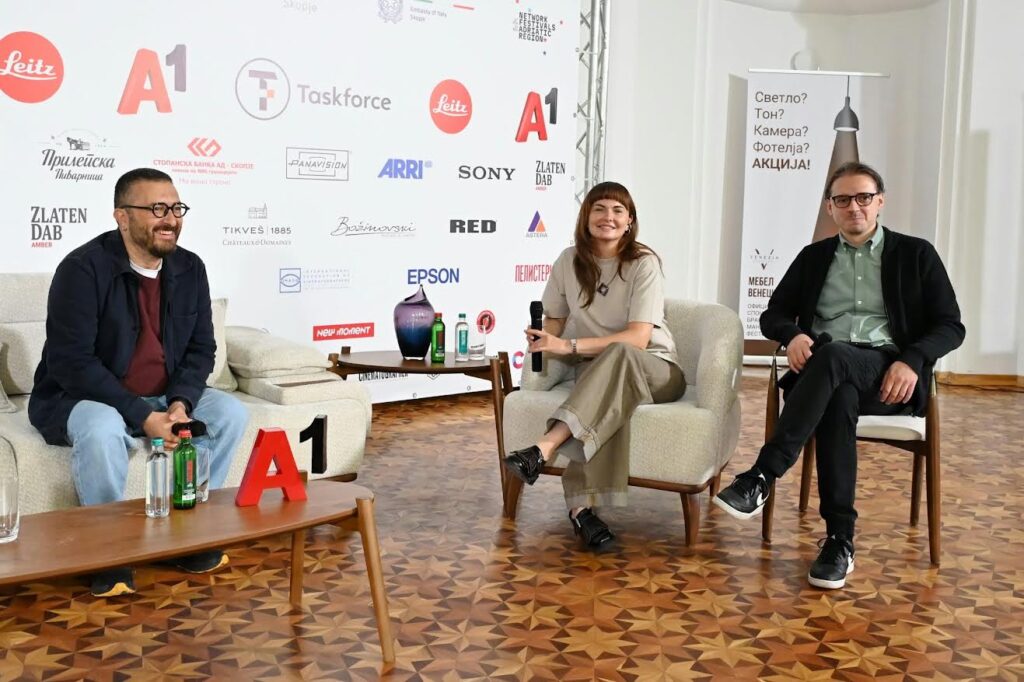
Janis Mazuch, the cinematographer of the film “Shame and Money”—a Macedonian co-production through the “List” production company that was screened last night in the main competition at the 47th ICFF “Manaki Brothers”— spoke at today’s press conference about the story, the challenges during the shooting, and more.
“We spent a year preparing for the shooting, scouting for locations across Prishtina because the director wanted the city itself—its landscapes and architecture—to play a significant role in the film. It was crucial to him for these elements to be integrated. He also wanted the camera to be as close as possible to the actors, following the
action and performances from a very close range to capture every emotion; essentially, he wanted the camera to become a member of the family rather than remaining at a distance. Sometimes he would place the actors in difficult situations —having them perform in the narrowest corners to capture the sense of desperation —which made filming challenging for me because lighting the scene was difficult”, said Mazuch, emphasizing what a great honor it is to have the film screened at “Manaki Brothers” and noting that this is his first time in Bitola.
He pointed out that the film incorporates documentary-style elements, as it features real day laborers standing on the streets of Pristina looking for work. Since the streets were not blocked off during the shooting, various unexpected events occurred, and reality intertwined with the acting — resulting, ultimately, in a very powerful cinematic experience.
“Black Money for White Nights” is the film that was screened last night as part of the Adriatic Audience Award Competition. Cinematographer Aleksandar Stanishev described it as a dark comedy where the main characters go about their lives striving for something beautiful—unaware that what they are doing is petty crimes.
“The directors take an extremely realistic approach to filmmaking; they don’t stylize the settings and aim to portray everyday life in Southeast Europe. Interestingly, some scenes were shot in a purely documentary style, placing the actors in real-life situations alongside actual people. I suggested making the film more cinematic—more playful, with brighter colors—and through elements like color and lighting, we managed to present tragic situations that also possess a comic, lighthearted aspect”, said Stanishev.
He added that they shot eight different endings for the film, noting that his best scenes were cut during editing because the filmmakers felt they were too beautiful and distracted from the main story.
Representing the documentary program at today’s press conference was Jacopo Falsetta, who worked as an animator on the film “Crossings: Kaleh Ziyarat”.
“It is currently almost impossible to film the Strait of Hormuz in a way that captures a clear image, so we had to find alternative ways to depict it. The director and I reached an agreement immediately; he was interested in the narrative and poetic aspects—elements unconnected to the current situation—and the historical component was important to him: who ruled there, the colonial period, and so on. We felt the story’s weight lay more in its history than in current events. We wanted to portray that endless flow of historical occurrences. The director is a researcher from Iran, and this project was part of his fieldwork; he was unable to obtain filming permits for the site — which features both growing modern structures and a vast archaeological history of ancient buildings — so he began connecting with local residents. This aroused police suspicion, leading to interrogations and his eventual expulsion, yet the footage he managed to capture became this very film”, said Falsetta.
Samir Ljuma, the cinematographer of the film “Nikola, Nikola”— which was screened as part of the short film selection — stated at today’s press conference that the short film selection itself deserves praise.
“I immediately agreed to collaborate on this project because the director is talented and knew exactly what he wanted; it was easy for me to translate his dream and vision into imagery. We are addressing a taboo subject, and the casting process was challenging. I am satisfied with the result; we had a clear vision of the film from the start and knew that a steadycam setup wouldn’t achieve the desired effect, so I shot it handheld” said Ljuma, who appeared at the press conference alongside the film’s lead actor, whom he described as very brave for accepting the role.
Marina Koloska, the cinematographer of the film “Birthing”, along with director Milena Vitman and producer Goce Kralevski, discussed the film’s story and the challenges involved.
“I’ve known Milena since she was a student; ten years later, she called me to work on the film. The story resonated with me, and we immediately understood each other. The collaboration was wonderful — we looked for a producer together, and the only thing we really debated about was the fact that cinematographers want to go darker while directors prefer to shoot in more light”, Koloska joked.
The director explained that the story contains autobigraphical elements and it is based on her personal experience; they initially shot one version of the ending, but a year later, the same crew got together again to shoot a different ending—also based on a personal story.
Producer Kralevski described the excellent collaboration with his colleagues and shared a few details and mishaps that occurred during filming, noting that everything turned out well in the end.
The Turkish actress Esra Gonen presented the film “A Swallow’s Journey”—screened as part of the special selection and co-produced by North Macedonia’s Alex Nikolić and Katerina Gabunija — at today’s press conference.
“I am very excited, and it is a great honor and pleasure to be in Bitola to present the film at the “Manaki Brothers” Festival. The director and I agreed to focus on the character’s journey, but I found it stressful because the character has many layers—layers she isn’t even aware of—and I wasn’t sure how I would capture all of that on camera. I tried to portray a child who learned to accept abuse from her father and, as an adult, feels guilt for having accepted it and not spoken up,” said Gonen.
Representing the Makpoint program at today’s press conference were Fejmi Daut, the cinematographer of the film “Dogs Have No Dreams”, and Hanis Bagashov, the film’s director, producer, and screenwriter.
“The shooting location was very difficult, which—along with the script, of course—was a challenge I was immediately drawn to. The location had no electricity, so we worked with whatever light was available. I’m used to such working conditions, so facing these challenges wasn’t an issue for me,” said Daut.
The film’s director and screenwriter, Bagashov, noted that they had tackled a taboo subject—one that frequently arises, particularly in this region.
Cinematographer Lazar Bogdanović presented the film “Fantasy” — co-produced by Macedonian producer Dejan Krajchevski — at a press conference today, highlighting the excellent collaboration with the Macedonian crew members.
“The subject matter was handled exactly as it should be. When I read the script, I found it fascinating that the story takes place in the Balkans, where such topics can be somewhat sensitive. We tried to set that aside and focus on the essence. The actresses were fantastic; they share a magical chemistry, even though each has a
distinct personality”, said Bogdanović.