


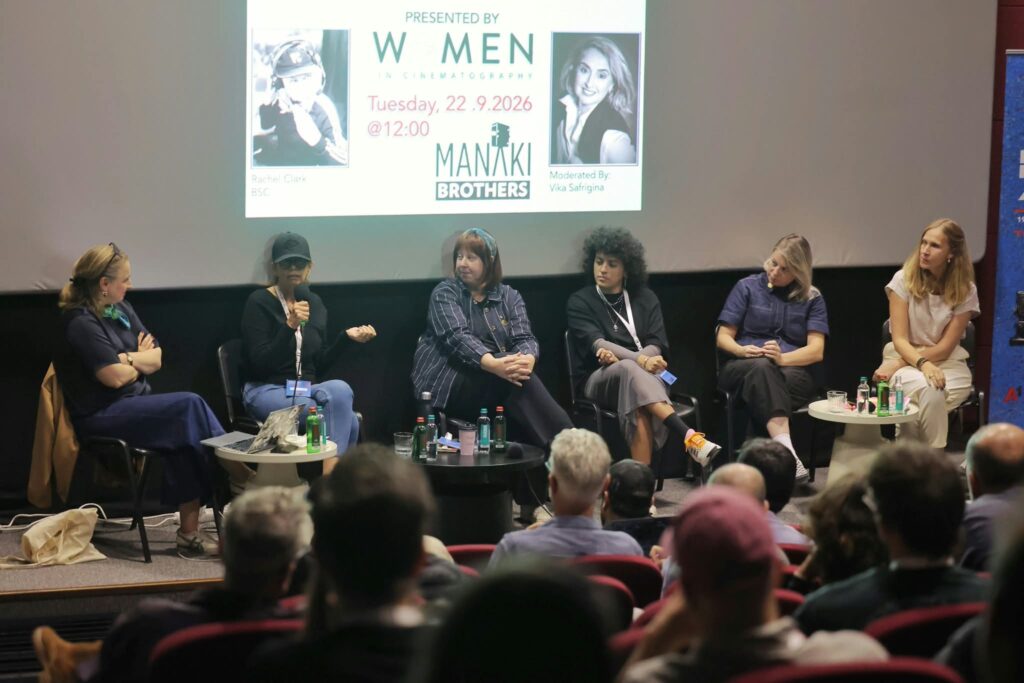
Mental health, setting boundaries, and conflict resolution were the focus of the “Mental Health, Boundaries, and Conflict Management” panel discussion, held as part of the “Women in Cinematography” (WIC) program at the Manaki Brothers Film Festival.
Cinematographers Nicola Daley, Olympia Mytilinaiou, Bojana Andrić, Adriana Berroteran and Rachel Clark participated in the panel, which was moderated by Vika Safrigina. The participants discussed the challenges women cinematographers face in a profession where long workdays, high pressures, intense on-set dynamics, and difficulties in achieving a work-life balance are often the norm.
Olympia Mytilinaiou, based in Athens, emphasized that gender inequality continues to affect how women are perceived and how their voice is heard on film sets.
“We live in a very male-dominated world, and this is even more pronounced in Greece. I once had a situation where two gaffers wouldn’t even listen to me simply because I was a woman. Yet, they would do exactly what the director said — they wanted to be close to him, but not to me. As a woman, it is difficult to make your opinion count”, said Mytilinaiou.
According to Bojana Andrić, one of the key prerequisites to preserve one’s mental health is thorough preparation, as well as the ability to completely disconnect from the professional obligations once the working hours are over.
“The first step is preparing for the task at hand, and then once we start work, I give my all to get it done right. In the end, I need to completely switch off from everything. I work in a small industry where everyone knows everyone else. The biggest threat to my mental health the is sexism. A large number of women face this, and it is truly terrible”, Andrić noted.
She also highlighted the results of a survey conducted among 500 cinematographers—an evenly gender-balanced group—which found that about half of the respondents had experienced burnout.
Rachel Clark also spoke about the experiences associated with excessive workloads, describing a moment when work began to impact her private life.
“I wouldn’t go home on weekends to see my family because I was too tired to drive. That’s when you know you’ve reached your limit,” Clark said.
Adriana Berroteran, meanwhile, shared an experience she had while shooting a short film with a director regarding whom there had been signs even before production began.
“A few months ago, we were shooting a short film with a difficult director. All the red flags were there — he wouldn’t show up, wouldn’t answer messages, sometimes for a day or two. I was told not to work with him; people were suing him for unpaid fees, and he would show up to the set drunk,” recounted Berroteran.
In Nicola Daley’s opinion, the ability to handle pressure and set healthy boundaries is something acquired through experience.
“When you’re a student, no one teaches you how to be resilient to stress. You learn that later,
on the job. I try to keep my emotions separate from my work. Yet burnout can set in even
after the work is done,” said Daley.
All the panellists agreed that caring for one’s mental health should not be separated from the daily practice of one’s job, and that it should become an integral part of how film production
is set up and organized.