


When I was a child, I didn’t like movies at all, but everything changed when I got my first camera at the
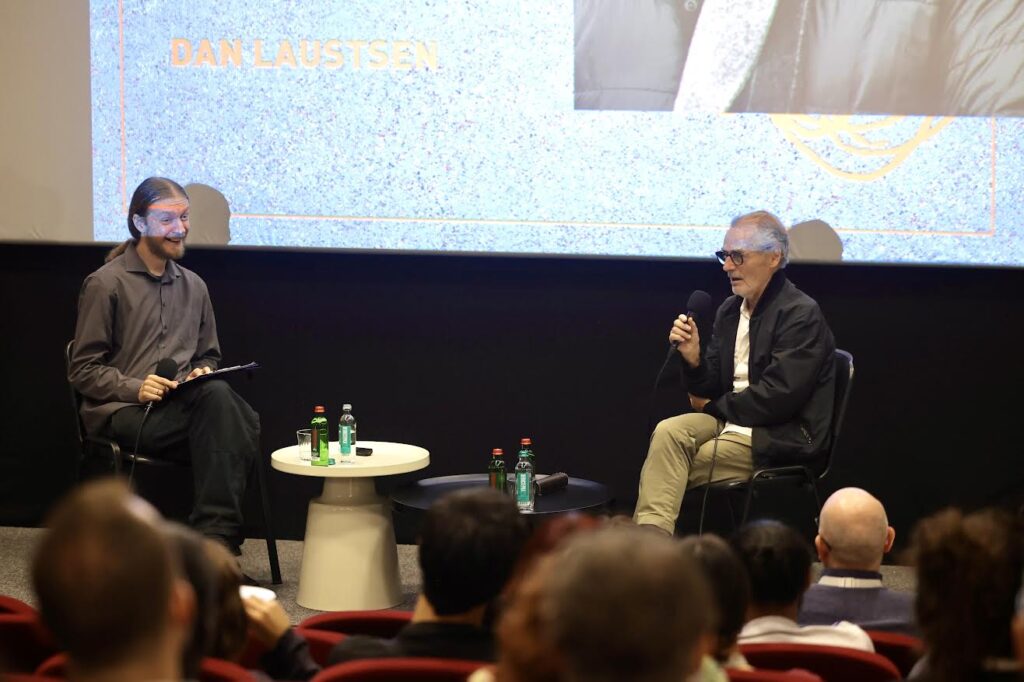
age of 14, said today Dan Laustsen, the winner of the “Golden Camera 300” lifetime achievement award, in front of the audience at the Manaki Cinema in Bitola, at the masterclass he held as part of the 47th edition of the
“Manaki Brothers” International Cinematographers Film Festival. At the masterclass moderated by Zlatko Gelevski, Laustsen spoke about his beginnings in cinematography, as well as about the experiences on the sets of the films he worked on.
“As a child I didn’t like movies at all. I went to the cinema and also watched comedies in the local theatre every Sunday afternoon. I come from a normal family, my parents were not involved in filmmaking, my mother was a teacher, so I don’t know where the love for the camera came from. At the age of 14, I bought a camera. There was no Internet then. I didn’t know anything and gradually learned. Don’t be afraid of your mistakes, and you should make a lot of mistakes. I started taking pictures with the camera and when I was 19 I wanted to apply to the Danish Film School. I always fell in love with the pictures I took. I sent them the pictures and they accepted me at the school,” said Laustsen.
He told the audience that throughout life there will be situations when someone wants to change your mind.
“But you have to listen to your heart, it’s very important. Everything is a struggle when you make films. I worked on my first feature film when I was 25. We were a small crew, but there’s nothing wrong with being a small crew. If you do what you love, you’ll get better every day. In the beginning, we didn’t have any money either, we had very few set-ups,” Laustsen added.
Talking about his approach in work, he said that faces look much more powerful when the light comes from one place, from one direction. It is one of the distinguishing features of his approach to lighting.
Laustsen often uses single-source lighting, that is, the light comes from one dominant source and from a clearly defined direction, instead of the face being evenly illuminated from several sides. For Nightmare Alley, Laustsen explained that they wanted lighting with a single light source and very direct light. For Frankenstein, however, he says that they did not use additional lighting and that they wanted lighting with a single source and deep shadows. This film was shot with an ARRI ALEXA 65 camera in large format. Thanks to the large format, Laustsen was able to get very close to the actors with close-ups, without the face appearing distorted. This allowed one shot to start as a very wide shot of the entire set, and then pan to a close-up of the actor, without changing the lens.
The Golden Camera 300 award winner is a visual genius of Hollywood. Laustsen is a Danish cinematographer, known for his collaborations with directors Chad Stahelski and Guillermo del Toro, for which he received three Academy Award nominations for Best Cinematography. He was born in 1954 in Aalborg, Denmark. He has been active since 1978 and has worked on more than 60 international productions. He is best known for his collaborations with Guillermo del Toro – The Shape of Water, Nightmare Alley, Frankenstein, Crimson Peak, Mimic Chad Stahelski – John Wick: Chapter 2, John Wick: Chapter 3 – Parabellum and John Wick: Chapter 4.